
Discover our Indian Heritage
The Story of Red Mud families; Narine, Balwant, Elahie, Fletcher, Phillip, and Gibbon Families
The Narine, Balwant, Elahie, Fletcher, Phillip, and Gibbon families are deeply rooted in the village of Red Mud in St. Patrick, forming part of the wider Indo-Grenadian community whose lives were shaped by agriculture, cultural traditions, and strong family connections.
These families established themselves in Red Mud over generations, building a community grounded in shared labour, cultural preservation, and mutual support. Their history reflects both the challenges and resilience of Indo-Grenadian life, as well as their contribution to the development of rural Grenada.
The Narine family traces its origins to Bihar in India, reflecting the broader movement of Indian indentured labourers who migrated to the Caribbean during the post-emancipation period. Their journey forms part of the wider Indo-Caribbean experience, rooted in resilience, adaptation, and cultural continuity.
The Balwant family holds a particularly significant place in the early history of Red Mud. Family accounts indicate that their ancestors migrated from India to Saint Vincent and the Grenadines before later settling in Grenada. They are regarded as among the first Indian families to establish themselves in Red Mud. One of the earliest known ancestors is Bohim Balwant, whose lineage forms an important part of the village’s foundation. While the exact ship of arrival is not known, their journey reflects the broader migration patterns of Indo-Caribbean families during that period.
Agriculture formed the backbone of life in Red Mud, and many members of the Narine, Balwant, Elahie, Fletcher, Phillip, and Gibbon families made their livelihood working on estates owned by Rupert Japal, Phil Japal, and George Japal. These estates provided steady employment and played a central role in sustaining the village economy.
Banana cultivation was especially important. Bananas harvested in Red Mud were transported to boxing plants in Samaritan, then sent onward to St. George’s for export to England. This process connected the labour of Red Mud villagers to international trade, highlighting their role in Grenada’s agricultural economy.
Alongside their agricultural work, these families maintained a strong cultural identity. Traditions were actively practiced and shared within the community, ensuring that Indo-Grenadian heritage remained visible and meaningful.
One of the most notable contributors to cultural life was Anna Balwant, who led an Indian dance group in Red Mud. Her group became well known within and beyond the village and was invited to perform at public events, including those held in Rainbow City. Through dance, music, and performance, she played a key role in preserving and promoting Indian cultural traditions within the community.
Cultural expression extended beyond organized performances. Villagers regularly gathered for music, singing, and dance, often accompanied by instruments such as drums and violin. These gatherings created a sense of unity and belonging and served as a means of passing traditions from one generation to the next.
The Gibbon family also contributed significantly to the cultural and spiritual life of Red Mud. Terrence Gibbon, now deceased, was well known for his deep love of music, a passion inherited from his Indian heritage. He was especially recognized for his skill in playing the violin, a talent that once drew the attention of GBN, who visited to capture and showcase his musical ability. In addition to his musical contributions, Terrence Gibbon served as the pastor of the Red Mud church, playing an important role in guiding the spiritual life of the community.
Weddings in Red Mud were important community events that reflected collective participation. Rather than being private occasions, they were held in open spaces within the village. Families contributed food, with women preparing dishes and men bringing drinks. The celebrations included traditional Indian attire, music, dancing, and the symbolic throwing of rice over the bride and groom as a blessing for prosperity. Decorative palm arches were also constructed, representing unity and the beginning of a new life.
A significant cultural practice within the community was the ceremonial first haircut, which was observed specifically for young boys. This ceremony typically took place just before the child began attending school, usually around the age of two, marking an important transition in early childhood.
A documented example from 1994 features Leon Phillip, whose hair-cutting ceremony brought together members of the Narine, Balwant, Elahie, Fletcher, Phillip, and Gibbon families. The occasion symbolized growth, readiness, and blessings for the child’s future.
The ceremony was a lively and communal event, often including music, singing, and dancing, accompanied by instruments such as drums and violin. It was customary for money to be thrown during the ceremony as a symbol of prosperity, which was later used to support the child’s future, particularly in relation to education.
Special care was taken with the child’s hair after it was cut. It was never discarded carelessly, as it was believed this could bring misfortune or affect future hair growth. Instead, the hair was respectfully collected, sometimes kept for a period of time, and later properly disposed of in keeping with cultural beliefs.
Education also formed part of the contribution of these families to Grenadian society. Emrol Narine served as a teacher at Samaritan Presbyterian School and later worked within the Ministry of Education. In addition to his role in education, he served as a Justice of the Peace, reflecting his continued commitment to public service and community development.
The Fletcher, Elahie, Phillip, and Gibbon families remained closely connected to agricultural work, cultivating crops such as nutmeg, bananas, and vegetables, and contributing significantly to both household livelihoods and the wider rural economy. Their work on estates and in farming sustained the community over generations.
Together, the Narine, Balwant, Elahie, Fletcher, Phillip, and Gibbon families represent a balanced and interconnected community. Their contributions span agriculture, culture, education, spiritual life, and social development, illustrating the ways in which Indo-Grenadian families built and sustained rural communities in Grenada.
Their legacy continues through the traditions they preserved, the land they worked, and the values they passed on. Through stories, photographs, and shared memory, the history of Red Mud remains an important part of Grenada’s cultural and social heritage.

Lennard Narine and his 3 daughters

Bohim Balwant and wife

Balwant Sisters

Anna Balwant and Lennard Narine

Bohim Narine at Samaritan Presbyterian Church

David and Georgie Narine

Emrol Narine

Desly Fletcher
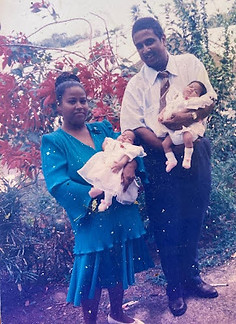
Desmond & Joyce Narine
Christening of baby twin Deslyn & Joycelyn

Gideon Elahie

Terrence Gibbon

George, Ellene & Leon Phillip