
Discover our Indian Heritage
The Rahaman Family: Migration, Faith, and Enterprise
The Rahaman family’s story begins in North India, in the district of Gonda, Uttar Pradesh. In 1845, their forebears departed Calcutta aboard the ship Fat Al Razak, arriving in Trinidad on May 30 of that year. They formed part of the early wave of Indian indentured migrants whose labour and resilience shaped the foundations of Indo-Caribbean society.
From these beginnings emerged a family guided by faith, discipline, and enterprise. Among them was Hafiz Yacoob Ali, a Muslim religious scholar, and Sakina Ali, a skilled seamstress. Their descendants established themselves in San Fernando, contributing to the economic and social development of the growing town.
In the generations that followed, Sheikh Fuzloo Rahaman, a businessman, and his wife Zobaida Jaleel, a respected businesswoman, continued this tradition of entrepreneurship and civic engagement. Through the maternal line, the family is also connected to Abdul Ghany, whose daughter Amina Ghany married Dr. Ashraf Ali, and later Sheikh Mohammed Jaleel, associated with the SMJ beverage enterprise.
Over time, members of the Rahaman family became active in commerce, industry, and community life in Trinidad, contributing to national development. Their reach extended beyond Trinidad, as family members migrated and established themselves across the Caribbean and further afield, carrying with them a tradition of enterprise, adaptability, and service beyond Trinidad.
The Bolah Family: Roots in Land and Labour
The Bolah family story is grounded in Grenada and begins with the arrival of Indian indentured labourers aboard the Maidstone on May 1, 1857.
Nathaniel DeAllie (I) and Jane Japal, both born in Grenada to indentured parents, established a family line rooted in hard work and land stewardship. Their daughter, Lena DeAllie, married James Bolah Jr., whose family traced its origins to Calcutta.
The Bolah family became closely associated with agriculture in St. Mark’s Parish. James Bolah Sr., an overseer at Belmont Estate, acquired and cultivated lands producing cocoa and nutmeg. These lands sustained the family across generations and supported education and advancement.
.jpeg)
.jpeg)
A Meeting of Histories
The Rahaman and Bolah families came together in St. George’s, where Zaid Azam Rahaman and Clearie Bolah became acquainted as young members of the community, each engaged in their respective daily pursuits.
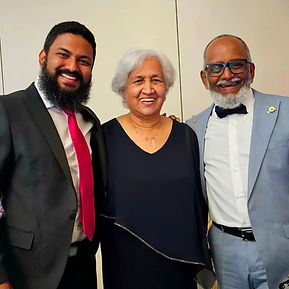
Their union brought together two Indo-Caribbean legacies, one shaped by enterprise and regional expansion, and the other grounded in land, agriculture, and generational continuity. Their marriage formed a strong foundation, and their children, Zaid, Salim, and Ziya Rahaman, would carry forward this legacy in distinct but complementary ways.
Building Enterprise in Grenada
The Rahaman family’s expansion into Grenada marked a defining chapter in their legacy of enterprise and national contribution. In 1958, members of the extended family established the Red Spot bottling plant in Mount Gay, laying an early foundation for industrial development on the island.
The family went on to establish and operate key commercial enterprises that became integral to Grenada’s business landscape. They founded Bobby’s Tyre Mart in 1970 and later established Spice Isle Retreaders Ltd. in 1984, strengthening the development of tyre services and industrial capacity in Grenada.
These ventures reflect a unified family effort, grounded in discipline, entrepreneurship, and a commitment to national development. Their contribution extended beyond business into civic life, including involvement in the Grenada Islamic Foundation, the Rotary Club, and the Grenada Chamber of Industry and Commerce.
A Contemporary Legacy: Leadership, Public Service, and International Representation
The Rahaman–Bolah legacy continues through the next generation, expressed in leadership across business, governance, and international engagement.
In Grenada, Salim Rahaman was appointed to the Senate in August 2022, representing the private sector. In this role, he contributes to national policy and economic discourse, with a focus on private sector development, trade facilitation, and the creation of an enabling environment for business. His work reflects the continuation of a family tradition rooted in enterprise, now extended into national governance and economic leadership.
This commitment to service and advancement extends beyond national borders into the international arena. His Excellency Ziya Rahaman, Consul General of Grenada and Head of Mission to Dubai and the Northern Emirates, assumed office in 2023.
Based in Dubai, he leads the Consulate General of Grenada, advancing the country’s diplomatic, economic, and cultural interests in the United Arab Emirates.
In this capacity, he works to strengthen bilateral relations, promote trade and investment, and support Grenadian nationals abroad. His leadership reflects a commitment to building meaningful international partnerships while positioning Grenada within a wider global network of opportunity. His background in Political Science, formal training in diplomacy, and longstanding engagement in social development inform a forward-looking approach to public service, including an interest in innovation and the role of technology in governance.
Together, these contributions represent a natural progression of the Rahaman–Bolah story, from migration and settlement, to enterprise and nation-building, and now to leadership at both national and international levels. They stand as a testament to a legacy defined by resilience, service, and an enduring commitment to advancing community, country, and global connection.